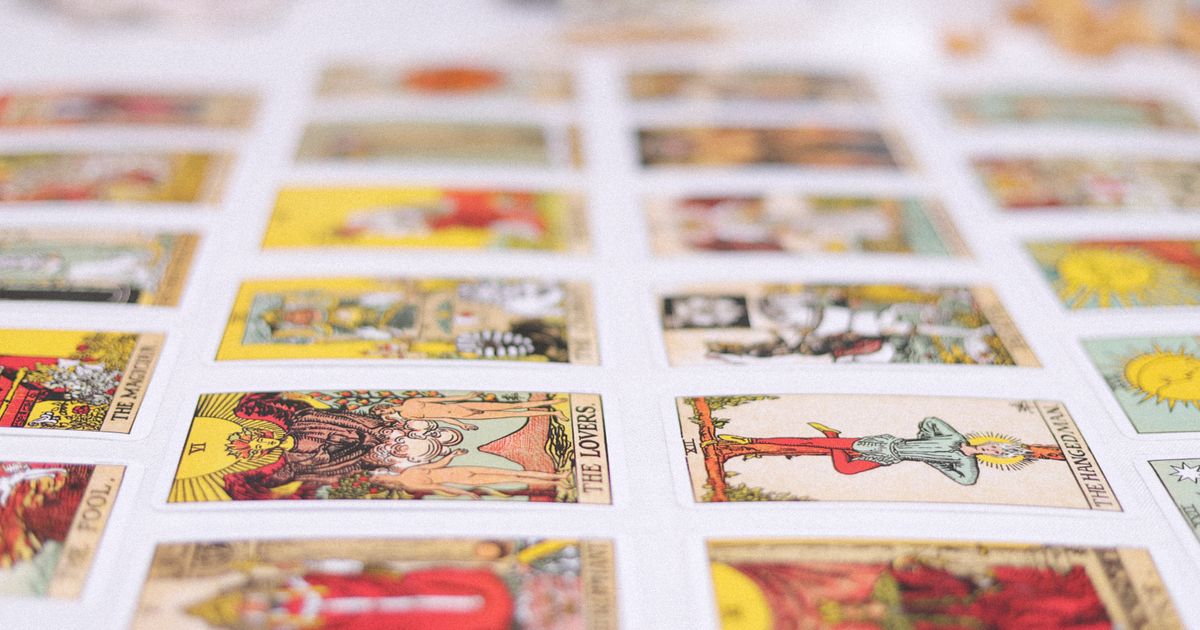
The major arcana destiny matrix connection is simple to state and rich to explore: the Destiny Matrix chart is built entirely from tarot’s 22 Major Arcana, the trump cards of a standard 78-card deck. Where a tarot reader shuffles and draws those cards at random, the Matrix computes them from your birth date and fixes them to positions on an eight-pointed star. Same 22 archetypes, two completely different engines. Understanding that relationship makes you better at both: the cards teach you the archetypes one draw at a time, and the chart shows you which of them the system associates with your life long-term. This guide covers where the 22 cards come from, how they became a birth-date chart, what changes between the two systems, and how to use them together without confusing what either one can do.
Curious which arcana sit in your own chart? Run the free calculator and read along with your numbers.
Key Takeaways
– The Destiny Matrix uses only tarot’s 22 Major Arcana, about 28% of a 78-card deck; the 56 Minor Arcana play no part in the chart.
– Tarot began as a 15th-century Italian card game, turned occult in the 1780s, and got its most familiar imagery in the 1909 Rider-Waite-Smith deck (Wikipedia: Tarot).
– Tarot draws cards randomly to read a moment; the Matrix computes them from your birth date to describe long-term patterns. Same archetypes, different engines.
– Tarot engagement skews sharply young: 23% of US adults under 30 consult tarot cards at least yearly, versus 3% of those 65 and older (Pew Research Center, 2025).
– Neither system predicts events. Both are archetype-based reflection tools, and they are most useful when you treat them that way.
Jump to a section:
- How Are the Major Arcana and the Destiny Matrix Connected?
- Where Do the 22 Cards Come From? A Three-Date History
- How Did Tarot Cards Become a Birth-Date Chart?
- Same Cards, Two Engines: Tarot Reading vs the Major Arcana Destiny Matrix Chart
- Do the Card Meanings Stay the Same in Both Systems?
- How Popular Is Tarot Right Now?
- How Do You Use Tarot Draws with Your Major Arcana Destiny Matrix Chart?
- What Can’t the Tarot-Matrix Connection Tell You?
- Frequently Asked Questions
New here? The pillar guide to the Destiny Matrix explains the whole system from zero.
How Are the Major Arcana and the Destiny Matrix Connected?
The Destiny Matrix is built from the Major Arcana, full stop. Every position in the chart, from your central Soul Arcana to the points on your Love Line and Karmic Tail, holds a number from 1 to 22, and each number is one of tarot’s trump cards: 1 is The Magician, 6 is The Lovers, 22 is The Fool. If you know the Major Arcana, you already know the Matrix’s entire vocabulary.
What the Matrix leaves out matters just as much. A standard esoteric tarot deck has 78 cards: the 22 Major Arcana plus 56 Minor Arcana arranged in four suits of 14 (Wikipedia: Tarot). The Matrix uses only the Major slice, roughly 28% of the deck, because the majors carry the big archetypal themes, the life-scale forces, while the minors handle day-to-day texture. A system claiming to describe your lifelong patterns has no use for the Eight of Pentacles’ Tuesday-afternoon energy.
Our 22 Major Arcana meanings guide walks through every card as it works inside the chart, and it is the natural companion to this article.
Where Do the 22 Cards Come From? A Three-Date History
Three dates carry the whole story of the Major Arcana, and none of them is ancient Egypt.
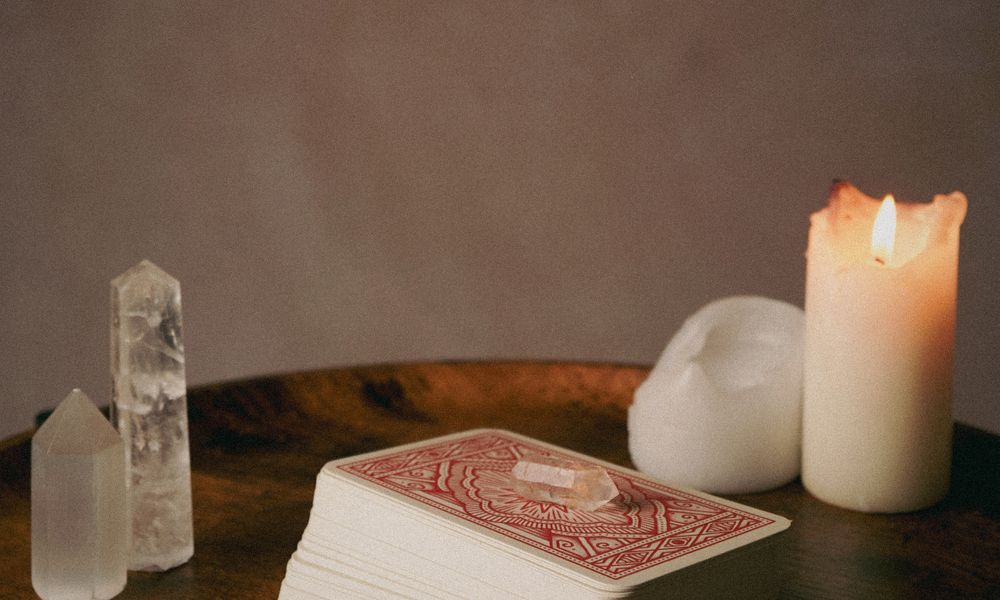
- The 1440s: a card game. Tarot appears in northern Italy as tarocchi, a trick-taking game for aristocrats, with the trumps as its special suit (Wikipedia: Tarot). For its first three centuries, nobody read fortunes with it.
- The 1780s: the occult turn. French writers, most famously Antoine Court de Gébelin and the professional cartomancer Etteilla, recast the deck as a repository of hidden wisdom and began using it for divination. Later occultists mapped the 22 trumps onto the 22 letters of the Hebrew alphabet and the 22 paths of the Kabbalistic Tree of Life (Wikipedia: Hermetic Qabalah), which is why the number 22 keeps reappearing across Western esoteric systems.
- 1909: the modern look. The Rider-Waite-Smith deck, directed by A. E. Waite and illustrated by Pamela Colman Smith, was published in London and became the visual template most decks and most readers use today (Wikipedia: Rider-Waite Tarot).
That lineage matters for the Matrix because the chart inherits everything: the archetypes stabilized by centuries of use, the RWS imagery most guides describe, and even the number 22 itself, which arrived as a game rule and stayed as a symbol.
How Did Tarot Cards Become a Birth-Date Chart?
The Destiny Matrix is commonly attributed to numerologist Natalia Ladini, who is said to have developed it around 2006 by combining the 22 Major Arcana with birth-date numerology on an eight-pointed star diagram. We say “commonly attributed” deliberately: the documentation is thin, the attribution circulates mainly through practitioner communities rather than independent sources, and details as basic as her nationality vary between tellings. An honest guide flags that rather than dressing it up as settled history.
The mechanism itself, though, is perfectly concrete. Your birth date is broken into components, each component is reduced to a number from 1 to 22, and any number larger than 22 is folded by adding its digits, so 23 becomes 2 + 3 = 5. One small housekeeping note: tarot decks number The Fool as 0, while the Matrix files the same card under 22, so the set of archetypes is identical even though the labels differ at that one card. Each resulting number takes a fixed position on the octagram, and each number is read as its corresponding Major Arcana card. The randomness of the card table is replaced by arithmetic: your chart is the same today, tomorrow, and in twenty years.
The clearest way to hold the difference: a tarot deck is random-access and the Matrix is fixed-address. A deck can hand any of the 22 trumps to anyone on any morning, which is what makes it a conversation. The Matrix assigns specific trumps to specific positions from a fixed input, which is what makes it a map. Neither mode is “more true,” but they answer different questions, and most confusion about the systems comes from asking one engine the other engine’s question.
For the position-by-position math, our chart positions guide covers every point on the star.
Same Cards, Two Engines: Tarot Reading vs the Major Arcana Destiny Matrix Chart
Put side by side, the differences come down to four things:
| Tarot reading | Destiny Matrix chart | |
|---|---|---|
| Selection | Shuffled and drawn at random | Calculated from your birth date |
| Timescale | The moment: today, this question | Standing patterns: temperament, cycles |
| Scope | All 78 cards in most traditions | The 22 Major Arcana only |
| Repetition | Every trump appears eventually, in random order | The same few arcana, fixed for life |
The weather-versus-climate framing captures it: a draw describes conditions, the chart describes tendencies. And the repetition row explains a familiar experience, because a card that sits in your chart starts to feel personal when it also turns up in a morning draw, even though any trump can appear in any shuffle.
The two engines reward different habits. Tarot rewards regular practice and attention, which is why we teach a five-minute daily tarot reading as the entry point. The Matrix rewards a single careful reading of your chart, revisited occasionally, the way you would reread a good map before a new leg of a journey.
Do the Card Meanings Stay the Same in Both Systems?
At the archetype level, yes: The Magician is still will and initiative, The Hermit is still solitude and inner search, The Tower is still sudden change, whether the card arrives by shuffle or by arithmetic. The Matrix did not invent new meanings; it borrowed tarot’s and pointed them at biography instead of the day’s events.
Two naming wrinkles are worth knowing, and both come from tarot itself rather than from the Matrix:
- The 8/11 swap. Older continental decks in the Marseille tradition number Justice as 8 and Strength as 11. The 1909 Rider-Waite-Smith deck swapped them, making 8 Strength and 11 Justice (Wikipedia: Major Arcana). Both orders survive today, which is why two Matrix calculators can disagree about what arcana 8 is called while agreeing completely about the math. This site and our arcana meanings guide use the RWS order: 8 is Strength, 11 is Justice.
- Softened names. Many Matrix readers rename the heavier trumps: Death (13) often appears as “Transformation” and The Devil (15) as “Temptation” or similar. The archetype underneath is unchanged, endings-and-renewal is endings-and-renewal, but the labels vary between schools and calculators.
If you ever compare two charts or two guides and the names differ, check the numbers. The numbers are the system; the names are dialect.
How Popular Is Tarot Right Now?
Tarot is having a measurably young moment. According to Pew Research Center’s May 2025 study, 11% of US adults consult tarot cards at least once a year, but the age gradient is steep: 23% of adults under 30, 13% of those 30 to 49, 6% of those 50 to 64, and just 3% of those 65 and older (Pew Research Center, “30% of Americans Consult Astrology, Tarot Cards or Fortune Tellers”, 2025). The archetypes may be six centuries old, but their current audience is disproportionately Gen Z and younger millennials.
The wider market tells the same story of steady, unspectacular growth: US psychic services are estimated at $2.3 billion in revenue for 2025 (IBISWorld, 2025), and the global tarot card market is forecast to grow by about $210 million between 2024 and 2029 (Technavio, 2025). This is a stable interest, not a bubble, and the Matrix is one of its newer expressions.
How Do You Use Tarot Draws with Your Major Arcana Destiny Matrix Chart?
Use the chart as your reference document and the deck as your daily practice. The combination works because each engine covers the other’s blind spot: the chart gives your draws a personal context, and the draws keep the chart from becoming a document you read once and forget.
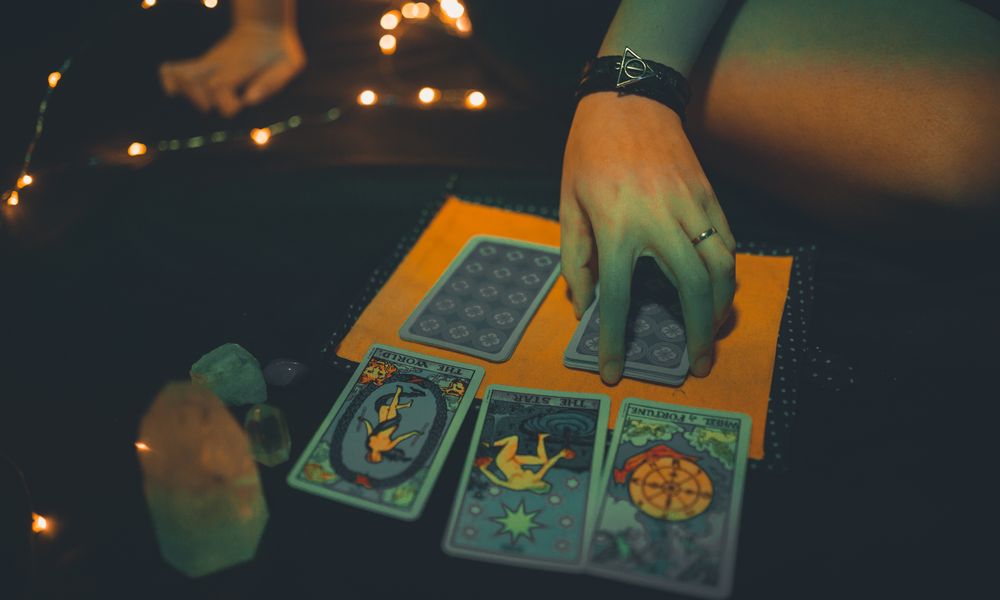
A simple three-step rhythm:
- Get the chart once. Run the free Destiny Matrix calculator, no email required, and note which arcana hold your central positions, especially your Soul Arcana.
- Draw daily. A one-card daily tarot reading takes five minutes, or use today’s card if you have no deck. Each draw teaches one archetype at a time, with your real day as the study material.
- Watch for your own cards. When a chart arcana appears in a draw, give it an extra minute. You are looking at the archetype the system already associates with you, showing up in today’s context. Treat it as a prompt to reflect on that pattern, not as a signal from the universe.
For a long stretch my daily draws kept surfacing The Hermit, a card that also sits prominently in my own chart, and I watched myself do the thing I now warn readers about: I started treating each appearance as confirmation of something fated. What actually helped was writing the draws down. On paper, The Hermit showed up during exactly the weeks I was overloaded with people and skipping my own thinking time, and the card stopped being an omen and became a meter. That is the connection working as it should: the chart named a lifelong tendency, and the deck flagged the weeks it was running hot.
What Can’t the Tarot-Matrix Connection Tell You?
The major arcana destiny matrix connection is archetypal, not predictive, and it is worth saying plainly. No study supports birth-date systems predicting life outcomes, and tarot draws are randomized card selection; the felt accuracy of both is well explained by the Barnum effect, our tendency to read personal meaning into resonant general statements. We lay out the full evidence, including the famous 4.30-out-of-5 Forer experiment, in our honest review of whether the Destiny Matrix is accurate.
What the connection genuinely offers is a shared vocabulary of 22 archetypes, refined over six centuries, that you can use from two angles: fixed, through your chart, and fresh, through the day’s draw. As a reflection practice that is plenty. As a fortune-telling machine it is nothing, and the readers who get the most from these tools are the ones who never confuse the two.
Frequently Asked Questions
Does the Destiny Matrix use all 78 tarot cards?
No. The major arcana destiny matrix chart uses only the 22 trump cards, which are about 28% of a standard 78-card deck. The 56 Minor Arcana are not part of the chart, because the system works at the archetype scale rather than the day-to-day scale the minors describe.
Do I need to know tarot to read my Destiny Matrix chart?
No, but it helps enormously. Every chart position is a Major Arcana card, so tarot knowledge transfers directly. If you are starting from zero, read your chart alongside an arcana meanings guide, and consider a daily one-card draw as a low-effort way to learn the 22 archetypes over time.
Why do some Destiny Matrix calculators name arcana 8 and 11 differently?
Because tarot itself has two numbering traditions. Marseille-style decks number Justice as 8 and Strength as 11; the 1909 Rider-Waite-Smith deck swapped them. Matrix calculators inherit one order or the other, so the names can differ while the underlying numbers and math agree. This site uses the RWS order: 8 is Strength, 11 is Justice.
Is drawing my Soul Arcana in a tarot reading a special sign?
It is a coincidence with good homework value. Any of the 22 trumps can appear in any draw, so your chart cards will turn up regularly by chance. Use those moments to reflect on the pattern the chart associates with you, rather than reading them as messages or omens.
Which should I start with, tarot or the Destiny Matrix?
Start with whichever lowers the barrier for you. The chart takes two minutes with a calculator and gives you a fixed map to explore; a daily draw takes five minutes and builds card knowledge gradually. They reinforce each other, so the honest answer is that the order matters far less than treating both as reflection tools.
Ready to see the connection in your own numbers? Generate your free Destiny Matrix chart, note your central arcana, then pull today’s card and watch how the same 22 archetypes speak in both voices.
Sources
- Wikipedia. “Tarot” (78-card structure; tarocchi origins c. 1440s northern Italy; 1780s occult turn via Court de Gébelin and Etteilla). Retrieved 2026-07-29. https://en.wikipedia.org/wiki/Tarot
- Wikipedia. “Major Arcana” (trump cards; RWS 8/11 Strength-Justice swap vs Marseille order). Retrieved 2026-07-29. https://en.wikipedia.org/wiki/Major_Arcana
- Wikipedia. “Rider-Waite Tarot” (published December 1909, A. E. Waite and Pamela Colman Smith). Retrieved 2026-07-29. https://en.wikipedia.org/wiki/Rider%E2%80%93Waite_Tarot
- Wikipedia. “Hermetic Qabalah” (22 trumps corresponding to 22 Hebrew letters and Tree of Life paths). Retrieved 2026-07-29. https://en.wikipedia.org/wiki/Hermetic_Qabalah
- Pew Research Center. “30% of Americans Consult Astrology, Tarot Cards or Fortune Tellers” (tarot by age: 23% ages 18-29, 13% ages 30-49, 6% ages 50-64, 3% ages 65+, 11% all adults; n = 9,593, surveyed Oct 2024). May 21, 2025. Retrieved 2026-07-29. https://www.pewresearch.org/religion/2025/05/21/3-in-10-americans-consult-astrology-tarot-cards-or-fortune-tellers/
- IBISWorld. “Psychic Services in the US – Industry Analysis” ($2.3B revenue, 2025). 2025. Retrieved 2026-07-29. https://www.ibisworld.com/united-states/industry/psychic-services/4413/
- Technavio. “Tarot Cards Market Analysis (2024-2029)” (forecast growth USD 209.7M). 2025. Retrieved 2026-07-29. https://www.technavio.com/report/tarot-cards-market-industry-analysis