

A daily tarot reading is a five-minute morning ritual: you shuffle, draw one card, and use its imagery as a prompt to think honestly about the day ahead. That is the whole practice, and done consistently it works less like fortune telling and more like guided journaling with better artwork. The card does not know what will happen today. What it does, reliably, is hand you a theme to check yourself against, and that small act of structured reflection is where regular readers get their value. This guide walks you through the exact one-card method, the questions worth asking, what the research on rituals and journaling actually supports, and the mistakes that turn a good habit into a superstition.
Want today’s card without a deck? Our daily tarot page draws one for you every day, free.
Key Takeaways
– A daily tarot reading is one card, one question, one written line. Five minutes is enough, and consistency beats ceremony.
– Tarot is mainstream, not fringe: 11% of US adults consult tarot cards at least yearly, rising to 23% of adults under 30 (Pew Research Center, 2025).
– Most readers already treat it the healthy way: twice as many engage “just for fun” as for “helpful insights,” and only 1% rely on it heavily for major decisions (Pew, 2025).
– The evidence supports the ritual, not the prophecy: structured rituals help regulate emotion (Hobson et al., 2018) and brief reflective journaling lowered anxiety in a one-month trial (Smyth et al., 2018).
– Expect the habit to take a while to stick: new daily habits reached automaticity in a median of 66 days, and missing a single day made no difference (Lally et al., UCL, 2010).
Jump to a section:
- What Is a Daily Tarot Reading?
- What You Need for a Daily Card Pull
- How Do You Do a Daily Tarot Reading? (5 Steps)
- What Should You Ask Before You Draw?
- What Does the Science Say About a Daily Card Ritual?
- How Do You Journal Your Daily Card?
- How Does Daily Tarot Connect to the Destiny Matrix?
- Common Daily Tarot Reading Mistakes and Their Fixes
- Frequently Asked Questions
New to the cards themselves? Our 22 Major Arcana meanings guide covers every card you will meet in this practice.
What Is a Daily Tarot Reading?
A daily tarot reading is a single-card draw done at a consistent time, usually in the morning, to set a theme for the day. Unlike a full spread, which maps a question across many positions, the daily pull asks almost nothing of you: one card, a moment of attention, and a line in a notebook. That simplicity is why it is the practice most readers actually keep.
It is also far more common than people assume. According to Pew Research Center’s 2025 study, 11% of US adults consult tarot cards at least once a year, and among adults aged 18 to 29 that figure rises to 23%, nearly one in four (Pew Research Center, “3 in 10 Americans Consult Astrology, Tarot Cards or Fortune Tellers”, 2025). The wider industry reflects the same interest: US psychic services are estimated at $2.3 billion in revenue for 2025 (IBISWorld, 2025), and the global tarot card market is forecast to grow by about $210 million between 2024 and 2029 (Technavio, 2025).
So if you are starting a daily practice, you are in large company. The rest of this guide is about doing it in a way that earns its five minutes.
What You Need for a Daily Card Pull
You need four things for a daily tarot reading: a deck, a consistent time and place, something to write in, and about five minutes. Nothing else on the accessory shelf is required.
- A deck you can read. For beginners the classic Rider-Waite-Smith imagery is the easiest to learn because most guides, including our Major Arcana meanings, describe its symbols. Any deck whose artwork speaks to you works.
- A fixed time and place. Morning with coffee, the same corner of the same table. Anchoring the draw to an existing routine is what turns it from an intention into a habit.
- A notebook or notes app. One line per day is the goal. The writing is not decoration, it is the mechanism, as the research below shows.
- Five minutes of actual attention. Phone face down. A rushed draw you ignore teaches you nothing; a short draw you sit with does.
No psychic gift is required, and this guide does not assume one. You are building a reflection habit that happens to use beautiful, centuries-old imagery as its writing prompt.
How Do You Do a Daily Tarot Reading? (5 Steps)
Here is the complete daily tarot reading method, start to finish. It is deliberately small, because the version you will still be doing in three months matters more than an elaborate one you abandon in a week.

- Settle for thirty seconds. Sit down, breathe once or twice, and let the mental browser tabs close. You are marking a boundary between “getting up” and “checking in,” which is a large part of what any ritual does.
- Hold one question. Not “what will happen today,” but something you can act on, like “what do I need to pay attention to today?” The next section gives you a menu.
- Shuffle until it feels done, then draw one card. There is no correct shuffle count. Cut the deck if you like, take the top card, and turn it over.
- Read the card as a mirror, not a message. Name what you see in the image, recall the card’s core meaning, then ask where that theme already lives in your day. The Tower before a difficult meeting is not predicting disaster; it is asking which structure in your life feels shaky, and what you would do if it moved.
- Write one line. Card name, plus one sentence connecting it to something real: “Strength, staying patient in the budget conversation instead of forcing it.” Close the notebook. You are done.
A quick word on reversed cards, since a card will eventually come out upside down: beginners can simply turn it upright and read it normally, which is a legitimate school of practice. When you are ready for more nuance, read a reversal as the same theme turned inward or blocked, a question of “where is this energy stuck?” rather than a darker fortune.
In the evening, if you remember, glance back at the line. Sometimes the theme showed up, sometimes it did not, and both results teach you something about how much weight to give any single card, which is exactly the calibration a thoughtful reader wants.
What Should You Ask Before You Draw?
Ask the card questions about attention and choice, not questions about outcomes. The card is a prompt, not a prophet, and the question you hold determines which one you get.
A useful test for any daily question: could you act on the answer before noon? “Will my interview go well?” fails the test, because nothing in the card changes what you do. “What energy do I want to bring into my interview?” passes, because whatever card appears, you leave the table with an intention. The one-card draw rewards questions where every possible card produces a usable answer.
Good daily questions:
- What do I need to notice today?
- What energy would serve me most this morning?
- Where am I likely to get in my own way today?
- What deserves my patience today?
- What am I avoiding that one small step would improve?
Questions to leave alone in a daily pull: anything with a yes or no, anything about another person’s feelings or choices, and anything medical, legal, or financial. Those are decisions for information and professionals, not for a single card before breakfast.
What Does the Science Say About a Daily Card Ritual?
The science supports the ritual and the writing, not the fortune telling, and being clear about that split makes the practice stronger, not weaker.
On ritual: a 2018 integrative review across psychology and neuroscience concluded that rituals serve real regulatory functions, helping people manage emotions, including anxiety, prepare for performance, and feel connected (Hobson et al., “The Psychology of Rituals,” Personality and Social Psychology Review, 2018). A structured, repeated morning sequence is precisely the kind of behavior that review describes.
On writing: in a randomized one-month trial, adults with elevated anxiety who did brief positive-focused journaling a few times a week reported lower anxiety and fewer depressive symptoms than usual care (Smyth et al., JMIR Mental Health, 2018). Your one line per day is a miniature version of that practice.
And on patience with yourself: a University College London study tracking new daily habits found they took a median of 66 days to become automatic, with a range from 18 to 254 days, and missing one day made no measurable difference (Lally et al., European Journal of Social Psychology, 2010). Give the practice two months before judging it.
Now the honest caveat. The card itself has no information about your day. When a reading feels uncannily specific, you are usually watching the Barnum effect, first demonstrated in 1949 when students rated an identical generic personality sketch 4.30 out of 5 for personal accuracy (Barnum effect). Tarot imagery is rich enough that some symbol will always match your morning. That is not a flaw to be embarrassed by; it is the engine of the practice.
The card’s job is to get a true thought out of you, and most tarot users seem to hold it in exactly that proportion: Pew found that among the 30% of Americans who consult these practices yearly, engaging “just for fun” outnumbers “helpful insights” two to one, and only 1% of US adults rely on them a lot for major decisions (Pew Research Center, 2025).
That “mostly for fun, lightly for insight” posture is the one this guide teaches. If you want the deeper version of this argument applied to birth-date systems, our honest review of whether the Destiny Matrix is accurate walks through the same evidence.
How Do You Journal Your Daily Card?
Journal your daily card in one line: the card’s name, then one sentence tying its theme to something concrete in your day. The template is “Card, situation, intention,” and it takes under a minute.
A few examples of the format:
- “The Hermit. Too many opinions on the redesign; I will draft my own answer before asking anyone else’s.”
- “Three of Cups. Haven’t seen Dana in a month; sending the text today.”
- “The Tower. The freelance income plan depends on one client; list two backup options at lunch.”
Once a week, read the last seven lines in one sitting. This weekly glance is where the practice quietly outperforms its reputation: patterns you cannot see day to day, like the third appearance of a boundary theme or a week of avoidance entries, become obvious in seven lines. You are building a dataset about yourself, and it is more honest than memory.
When I started my own daily practice I skipped the writing for the first month, and I can tell you exactly what I retained from those thirty draws: nothing. The cards blurred together and the ritual felt increasingly decorative. The day I started writing one line, the practice changed character, because a week later I could see that I had pulled my way through a whole run of conflict-avoidance themes while telling myself everything was fine. The deck did not know that. The notebook did.
How Does Daily Tarot Connect to the Destiny Matrix?
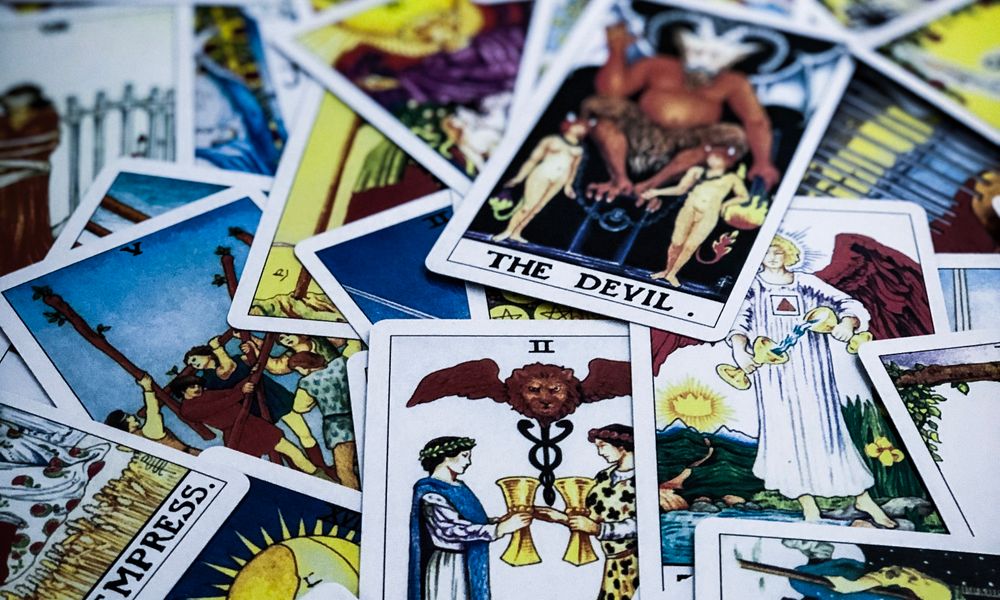
Daily tarot and the Destiny Matrix run on the same 22 cards. The Major Arcana you meet one at a time in your morning draw are the same arcana the Destiny Matrix chart arranges from your birth date, so each practice deepens the other (the full story of that relationship is in our Major Arcana and the Destiny Matrix guide): the daily pull teaches you the cards’ characters slowly and personally, while the chart shows you which of those characters the system associates with you long-term.
A natural way to combine them:
- Learn by drawing. Your daily card introduces the arcana in random order, one honest morning at a time. Keep the 22 arcana guide open while you learn.
- Get your chart once. Run the free Destiny Matrix calculator and note your central arcana. No email required.
- Notice the crossovers. The first time your own Soul Arcana turns up in a morning draw, you will read that card with entirely different attention. Treat it as a nudge to revisit what that arcana means in your chart, not as a cosmic signal.
Both tools are reflection instruments built on the same imagery. Neither one predicts your Tuesday.
Common Daily Tarot Reading Mistakes and Their Fixes
The most common daily tarot reading mistakes are redraws, doom-reading, outsourcing decisions, and quitting over missed days. All four have simple fixes.
- Redrawing until a nicer card appears. This trains you to consult the deck the way you refresh social media, for a hit of reassurance. One card, whatever it is. If it stings, that is material for the journal line, and usually the most useful entry of the week.
- Doom-reading Death and the Tower. In the Major Arcana these are cards of transformation and collapsing structures, not literal catastrophe. Every card in the deck describes an energy that can be met well or badly; our arcana meanings guide gives the balanced reading for each.
- Letting the card make real decisions. The card frames your thinking; it does not cast a vote. Pew’s data shows only 1% of US adults rely heavily on these practices for major decisions, and that restraint is the correct model. Money, health, relationships and career decisions get made with information, professionals, and the people involved.
- Quitting because you missed three days. The UCL habit research found missed days did not derail habit formation. A daily practice is defined by its average, not its streak. Shuffle, draw, write your line, and continue.
Frequently Asked Questions
What is the best time of day for a daily tarot reading?
Morning is best for most people because the card can frame the day ahead, and attaching the draw to an existing anchor like coffee makes the habit stick. But consistency beats timing: an evening review draw works equally well if that is when you reliably have five quiet minutes.
Do I need to be psychic to read tarot for myself?
No. A daily tarot reading as taught here is a reflection practice: the card offers a theme and you supply the meaning by connecting it honestly to your day. No claim of supernatural ability is required, and the practice works fine without one.
What if I draw a “bad” card like Death or the Tower?
Read it as a theme, not a forecast. Death speaks to endings and transformation, the Tower to structures under strain, and both become practical questions: what is ending, what feels unstable, what would I do about it? A challenging card usually produces the most useful journal line.
Should I pull one card or three cards daily?
Start with one. A single card keeps the ritual under five minutes, which protects the habit, and it forces a depth of attention that spreads dilute. Add a three-card past-present-future spread on weekends if you want more, once the daily habit is established.
Can a daily tarot card predict my day?
No. There is no evidence any card system predicts events, and readings feel accurate mainly through the Barnum effect, our tendency to find personal meaning in general statements. The card’s real function is prompting reflection you would not otherwise do, which is also why the practice remains worth five minutes.
Ready for your first daily tarot reading? Draw today’s free card right now, write your one line, and if you want to see how the same 22 arcana map onto your birth date, run the free Destiny Matrix calculator when you are done.
Sources
- Pew Research Center. “3 in 10 Americans Consult Astrology, Tarot Cards or Fortune Tellers.” May 21, 2025. Retrieved 2026-07-23. https://www.pewresearch.org/religion/2025/05/21/3-in-10-americans-consult-astrology-tarot-cards-or-fortune-tellers/
- IBISWorld. “Psychic Services in the US – Industry Analysis.” 2025. Retrieved 2026-07-23. https://www.ibisworld.com/united-states/industry/psychic-services/4413/
- Technavio. “Tarot Cards Market Analysis (2024-2029).” 2025. Retrieved 2026-07-23. https://www.technavio.com/report/tarot-cards-market-industry-analysis
- Hobson, N. M., et al. “The Psychology of Rituals: An Integrative Review and Process-Based Framework.” Personality and Social Psychology Review, 22(3). 2018. Retrieved 2026-07-23. https://journals.sagepub.com/doi/abs/10.1177/1088868317734944
- Smyth, J. M., et al. “Online Positive Affect Journaling in the Improvement of Mental Distress and Well-Being in General Medical Patients With Elevated Anxiety Symptoms.” JMIR Mental Health, 5(4). 2018. Retrieved 2026-07-23. https://pmc.ncbi.nlm.nih.gov/articles/PMC6305886/
- Lally, P., et al. “How are habits formed: Modelling habit formation in the real world.” European Journal of Social Psychology, 40, 998-1009. 2010. doi:10.1002/ejsp.674. Summary via UCL Health Chatter, retrieved 2026-07-23. https://blogs.ucl.ac.uk/bsh/tag/66-days/
- Barnum effect (Bertram Forer, 1949). Retrieved 2026-07-23. https://en.wikipedia.org/wiki/Barnum_effect